What AI-Driven App Development really means for operators
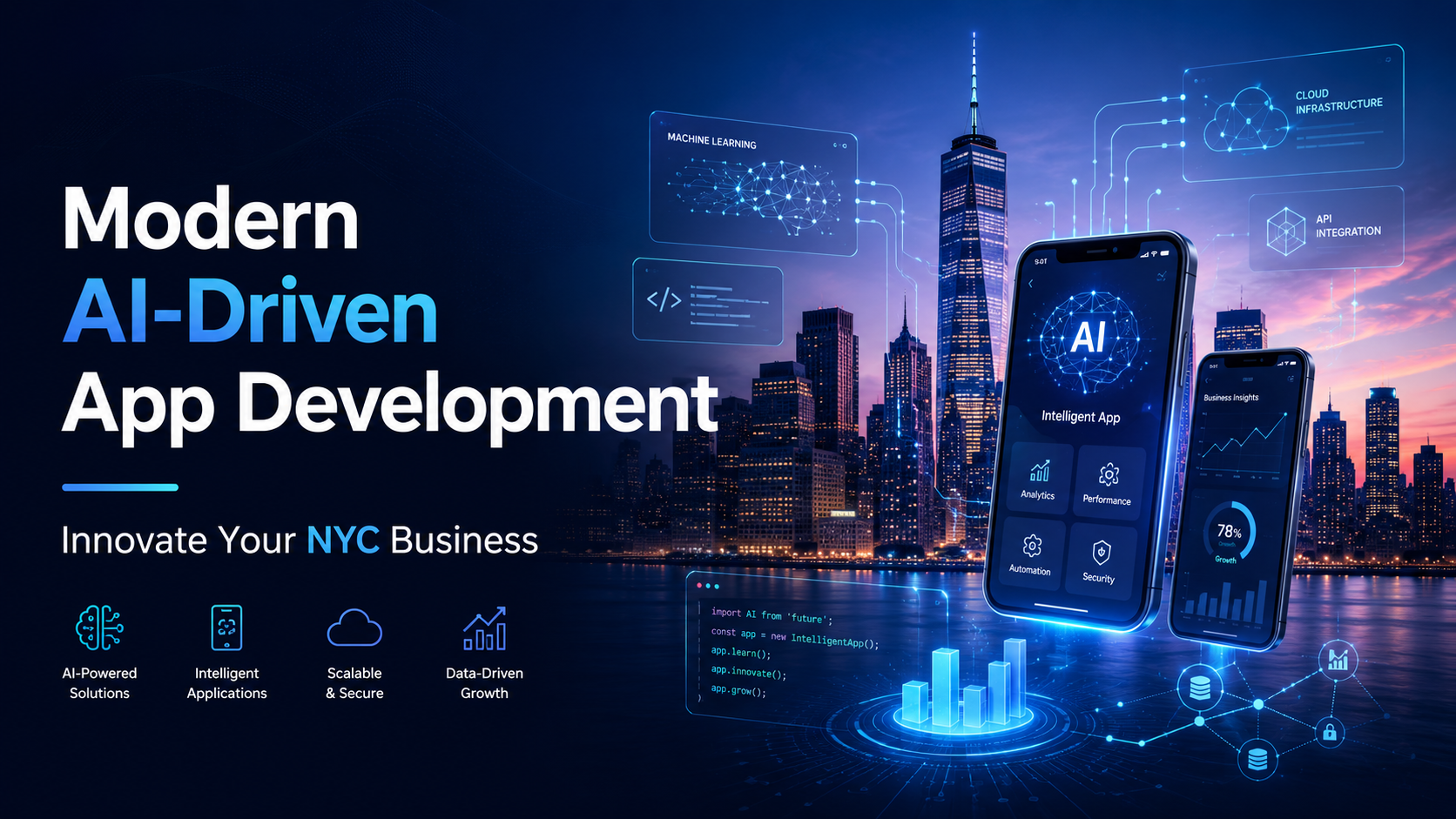
AI-Driven App Development describes building software where artificial intelligence models and data-driven workflows are core to the user experience, decision-making, or automation. For operators, that shifts projects from feature-first roadmaps to data-and-model-first roadmaps. Requirements, telemetry, and governance matter as much as UI flows.
The phrase appears throughout this article because it captures the practical focus operators need: using AI to solve concrete problems, reduce manual work, and improve outcomes.
Operators should treat AI-Driven App Development as a systems problem. Instead of plugging a model into an existing app as an afterthought, teams identify the specific decisions the AI will support. They instrument data collection and design interfaces that make model outputs actionable and auditable.
That approach minimizes risk and aligns technical investment with measurable business KPIs.
Practical benefits and trade-offs
Adopting AI-Driven App Development brings measurable benefits but also trade-offs. Knowing both lets you plan realistic timelines and budgets.
Benefits
- Improved efficiency: Automation of repetitive tasks reduces operational overhead and error rates.
- Personalization at scale: AI can tailor experiences in real time, increasing engagement and conversion.
- Faster decision support: Models can surface insights from large data sets faster than manual analysis.
- Competitive differentiation: Thoughtful AI features can create new revenue streams or reduce churn.
Trade-offs and risks
- Data requirements: High-quality, labeled data is often the gating factor. Expect effort to collect, clean, and maintain training data.
- Model maintenance: Models drift; ongoing monitoring and retraining are required to preserve accuracy.
- Complexity in infrastructure: Serving models at scale introduces latency, cost, and security considerations.
- Regulatory and ethical concerns: Explainability, bias mitigation, and privacy controls need embedding from day one.
How Flexus approaches delivery
Flexus treats AI-Driven App Development as a cross-functional delivery challenge. Product strategy, data engineering, ML model development, and reliable cloud operations must ship together.
Our Indianapolis-based team blends U.S. product leadership with U.S. + India delivery to balance cost, speed, and continuity.

Discovery and alignment
Every project begins with a short discovery sprint to define the decision the AI supports. We map data availability, outline success metrics, and produce a delivery plan with milestones. This reduces rework and ensures the first model iteration delivers measurable value.
Data engineering and labeling
We implement instrumentation and ETL pipelines that normalize inputs, log predictions, and capture feedback for continuous improvement. Where labeling is needed, we combine automated pipelines with human review to maintain quality.
Model selection and integration
We choose models pragmatically: off-the-shelf APIs or fine-tuned proprietary models depending on latency, cost, and control requirements. Integration is implemented as modular services so models can be swapped or updated with minimal disruption.
Deployment and observability
Production delivery includes performance SLAs, canary releases, and full observability. This encompasses prediction accuracy tracking, drift alerts, input distribution monitoring, and audit logs. This ensures teams can operate models safely at scale.
Security and compliance
Security is layered: data encryption, role-based access, and secure model hosting. For regulated use cases, we implement additional controls and documentation to support audits.
Implementation checklist
This checklist converts strategy into tactical steps you can apply to your next AI-Driven App Development initiative.

- Define the decision: Specify the exact business decision the model will support and the KPI that will indicate success.
- Identify data sources: Inventory available data, assess quality, and estimate labeling effort.
- Choose metrics: Select primary and secondary evaluation metrics (precision/recall, business impact, latency).
- Prototype fast: Build a lightweight proof-of-concept with a realistic dataset to validate assumptions before full development.
- Plan for retraining: Establish retraining cadence, data pipelines, and who owns model health monitoring.
- Instrument for feedback: Capture user feedback and outcomes to create a loop for continuous improvement.
- Governance and explainability: Implement logging and reporting so decisions can be explained to stakeholders and auditors.
- Operational readiness: Ensure scalable serving, rollout strategies (canary/blue-green), and fallback behavior if the model is unavailable.
- Cost modeling: Project compute, storage, and monitoring costs; consider serverless or hybrid hosting to optimize spend.
- Stakeholder communication: Align product, legal, security, and operations on launch criteria and post-launch responsibilities.
Conclusion
AI-Driven App Development is a practical, measurable path to make products smarter and teams more productive. Success requires treating models as part of the product lifecycle: from data and metrics to deployment and governance.
Flexus brings 18+ years of delivery experience and a hybrid U.S. + India model to help teams move from prototype to production with clear SLAs and observability.
Ready to scope your next AI-Driven App Development project? Setup an Appointment with Flexus Solutions to review your use case and get a pragmatic delivery plan.
FAQ
Frequently asked questions
What should I look for in AI-Driven App Development?
Look for teams that prioritize data quality, clear success metrics, and operational readiness. Ensure they can instrument production telemetry, monitor model drift, and provide explainability and governance controls. Practical experience integrating models into user workflows is essential.
How does Flexus help with this?
Flexus combines product strategy, data engineering, ML integration, and cloud operations. We run discovery sprints, build ETL and labeling pipelines, select or fine-tune models, and implement production observability and security. Our delivery blends U.S. product leadership with U.S. + India engineering capacity.
How long does a typical project take?
Timelines vary by scope. A focused proof-of-concept can take 4–8 weeks. Production-ready projects, including data pipelines and governance, commonly span 3–6 months. We start with a discovery sprint to produce a realistic schedule and milestone plan.
How do I get started?
Start with a short discovery sprint to define the decision you want to automate or augment, map existing data, and agree on success metrics. Contact Flexus to Setup an Appointment and we'll scope a discovery aligned to your priorities.