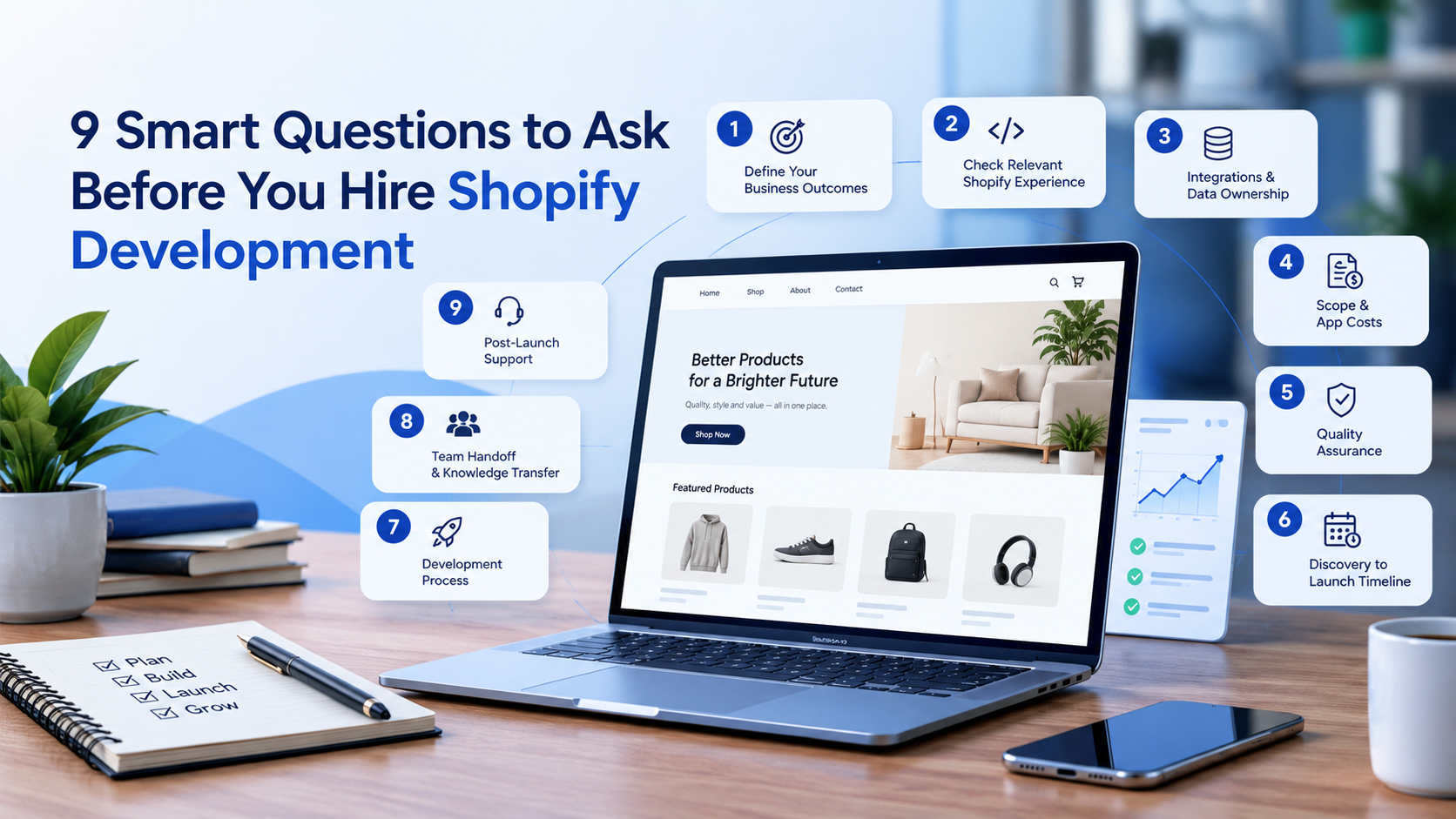
Choosing to hire Shopify Development support is not simply a design decision; it affects conversion paths, operations, customer trust, and the ability to change your store without creating new problems. This guide helps ecommerce leaders, marketing teams, and growing brands ask better questions before they commit budget to a Shopify partner or specialist.
Short Summary
- Start with outcomes: Define the business problem, customer journey, and measurable priorities before discussing features.
- Check relevant depth: Ask for Shopify experience that matches your catalog, integrations, migration, or custom storefront needs.
- Plan the handoff: Clarify ownership, documentation, training, launch support, and the post-launch change process.
- Protect performance: Treat app selection, theme code, accessibility, and quality assurance as part of the build—not cleanup work.
- Choose a working model: Compare a freelance Shopify developer, a dedicated resource, and an agency against your internal capacity.
What hire Shopify Development really means for operators
For an operator, the decision to hire Shopify Development means putting a production revenue channel in someone else’s hands. The work can range from configuring a standard theme and product data to building custom sections, connecting ERP or fulfillment systems, migrating an existing store, and improving checkout-adjacent experiences. The right scope begins with the operational problem behind the request, not a list of visual preferences.
 Operators map priorities before choosing a path
Start by asking: what must be easier, safer, faster, or more profitable after this work is complete? A direct-to-consumer brand may need faster collection discovery and subscriptions. A B2B seller may need account-specific pricing, wholesale workflows, or integrations with a back-office platform. A replatforming team may need clean product data, preserved search visibility, redirects, and a launch plan that minimizes disruption.
Question 1: What business outcome are we trying to improve?
A capable shopify expert developer should help translate an outcome into requirements. “Improve the product page” is vague; “reduce customer questions about sizing, improve mobile add-to-cart completion, and make merchandising updates possible without code” is actionable. Agree on the audience, the current friction, the expected behavior change, and the signals that will tell you whether the change worked.
This conversation also prevents an expensive mismatch. A store with low-quality product information may not benefit much from animation or a new app. A store with a slow, cluttered theme may need technical simplification before it needs a visual refresh. The best partners respectfully challenge assumptions and distinguish a must-have launch requirement from a later experiment.
Question 2: Which Shopify capabilities and constraints apply to our store?
Shopify plans, checkout requirements, product complexity, market expansion, subscriptions, customer accounts, and existing apps all shape the solution. Ask candidates to explain what they would use natively, what requires an app, and what deserves custom development. Their answer should include trade-offs around cost, maintainability, merchant usability, and future upgrades.
Ask specifically how they handle integrations and data ownership. An integration can affect inventory accuracy, order routing, customer records, tax calculations, and support workflows. Good expert Shopify developers identify the source of truth for each data type and flag where a connector, API, middleware, or manual process may create risk.
Question 3: Can you show work similar in complexity, not merely similar in appearance?
A polished portfolio is useful, but it does not prove that a provider can manage your operational reality. Ask for examples that resemble your challenge: a migration with redirects, a store with variants and bundles, a subscription setup, a custom product configurator, or a third-party system connection. Do not require confidential details; ask instead for a clear explanation of decisions, constraints, testing, and what they would do differently.
Whether you hire shopify expert support from an agency or individual, evaluate communication as carefully as code. You need someone who can explain risks in plain language, document decisions, and make a recommendation when requirements conflict. That discipline is especially valuable when marketing, operations, and technology stakeholders all have valid but competing needs.
18+years delivering digital work
U.S. + Indiadelivery capability for collaborative execution
Practical benefits and trade-offs
Hiring Shopify help can accelerate progress, bring specialized knowledge into a small team, and reduce the burden on internal staff who already own merchandising or marketing. It can also introduce coordination overhead, recurring app costs, and dependency if responsibilities are unclear. The goal is not to eliminate every trade-off; it is to choose a delivery model that fits your pace, complexity, and appetite for ongoing ownership.
 Comparing options against delivery constraints
Question 4: Should we use a freelancer, a dedicated developer, or an agency team?
A freelance shopify developer can be a strong choice for a focused set of tasks, a small enhancement backlog, or an established team that can provide direction and quality review. The model is often straightforward, but continuity can depend on one person’s availability. Confirm who handles project management, design coordination, testing, documentation, and urgent launch issues before work begins.
To hire dedicated shopify developer capacity can make sense when you have a sustained roadmap and a product owner who can provide prompt feedback. It offers continuity and domain learning, but it still needs defined priorities, review standards, and a backup plan for specialized needs. A dedicated resource is not a substitute for a clear backlog.
An agency is often better suited to projects requiring coordinated strategy, UX, development, quality assurance, and release management. It may cost more than an individual for a simple task, but it can reduce handoffs for a complex launch. Flexus combines an Indianapolis-based agency presence with U.S. and India delivery, helping teams access coordinated skills while keeping planning and communication practical.
Question 5: How will you control scope, cost, and app sprawl?
Ask for an estimate that separates discovery, design, configuration, custom development, integrations, testing, launch, and post-launch support. A responsible estimate states assumptions: number of templates, expected revision rounds, systems involved, content readiness, and who supplies product data. It should also name the items that could change the cost, rather than hiding uncertainty behind a single confident number.
Apps can solve real problems quickly, but each one adds cost, dependencies, scripts, permissions, and a possible support path. Ask a candidate to justify each recommended app, identify alternatives, and explain how it affects speed or maintainability. For performance guidance, review Shopify’s own theme performance best practices alongside the proposed approach.
- Prefer native features when they meet the requirement without adding an operational burden.
- Use established apps for well-defined functions such as reviews, subscriptions, or search when custom code offers little strategic advantage.
- Build custom functionality when the workflow differentiates your business or when an app would force costly workarounds.
- Document every dependency so a future team knows why it exists, who owns it, and what happens if it is removed.
Tip: Ask every candidate to identify one feature they would postpone until after launch. A thoughtful answer shows they can protect the critical path instead of agreeing to every request.
Question 6: What will quality assurance cover?
“We test it” is not enough. Request a test plan covering major browsers, mobile breakpoints, navigation, search, cart behavior, discounts, customer account flows, transactional emails, analytics events, integrations, and accessibility basics. If your store serves multiple markets, test currency, tax, shipping, language, and fulfillment scenarios that match your actual operations.
Quality assurance should include merchant workflows, not only shopper clicks. Your team needs to create products, update content, run promotions, fulfill test orders, and understand how changes move from staging to production. Ask how defects are logged, prioritized, retested, and approved so launch readiness is based on evidence instead of a vague sense that the store looks finished.
How Flexus approaches delivery
At Flexus, Shopify work starts by making the delivery path visible: business goals, customer journeys, system dependencies, owners, risks, and launch criteria. That approach helps prevent a familiar problem in ecommerce projects—discovering late that a design request affects inventory, fulfillment, promotion rules, or the people who must operate the store every day.
 Cross-functional delivery from design through build
Question 7: What happens between discovery and launch?
Discovery turns broad goals into a prioritized scope. We review the current storefront or planned commerce model, catalog structure, integrations, content readiness, analytics needs, and key user journeys. The output is not just a feature list; it is a practical plan that identifies decisions, dependencies, milestones, and the inputs needed from your team.
During design and build, we focus on reusable components and clear merchant controls where appropriate. A flexible section system can let a marketing team refresh campaigns without requesting code changes for every update. For more specialized needs, custom development is evaluated against the cost of maintaining it, the value it creates, and the alternatives available in Shopify’s ecosystem.
Our Shopify development services can support new storefronts, redesigns, migrations, integrations, and ongoing improvements. The working rhythm includes regular review points, visible priorities, and direct discussion of decisions that could affect timing or budget. This is especially important when distributed delivery is involved: clear requirements and shared acceptance criteria keep progress accountable.
Question 8: How will you prepare our team for ownership?
A launch is a handoff into ongoing operations, not the finish line. We plan for training on the parts of Shopify your team will use, including content updates, collections, promotions, product changes, and basic troubleshooting boundaries. Documentation should tell staff what is configurable, what is custom, which apps matter, and when to request technical help.
The strongest Shopify build is one your team can operate confidently the day after launch.
We also recommend defining a post-launch observation window. Monitor orders, payment and fulfillment handoffs, conversion-critical pages, site speed, customer questions, and analytics data. Small fixes and refinements are normal after real customers begin using a new experience; the important point is to have a known route for prioritizing them.
Question 9: What support model follows launch?
Before signing, ask who responds to defects, who manages enhancements, what information is needed to request work, and how urgent issues are handled. A reliable partner distinguishes a production defect from a new feature request and gives your team a sensible way to make both visible. This keeps the relationship focused on business value rather than a stream of unstructured messages.
For organizations that need adjacent help beyond the storefront, related work may include content, conversion-focused design, or broader platform planning. Our website design FAQs are a useful reference when design governance and user experience questions are part of the larger initiative.
Setup an Appointment to discuss your Shopify goals, constraints, and delivery options.
Implementation checklist
Use this checklist before selecting a provider or approving a Shopify statement of work. It gives stakeholders a shared way to evaluate proposals and reduces late-stage surprises caused by missing content, unclear ownership, or untested integrations. Treat each item as a decision to record, not merely a question to ask once.
 A practical checklist keeps launches on track
- Define the commercial objective. Write the primary outcome, target customer, key journey, baseline metric, and the decision you hope the project will improve. Include constraints such as launch date, budget range, legal requirements, and internal staffing.
- Inventory the current environment. List your Shopify plan, theme, apps, domains, analytics tools, product information sources, payment methods, fulfillment tools, and connected systems. Note who owns access and who can make production changes.
- Prioritize requirements. Divide work into launch-critical, valuable soon after launch, and exploratory ideas. Include acceptance criteria for critical journeys, such as successful purchase, account access, discount handling, and accurate inventory behavior.
- Request a delivery plan. Ask for phases, roles, assumptions, design review points, build milestones, QA activities, launch steps, and post-launch coverage. Compare proposals by what is included and excluded, not price alone.
- Validate the technical approach. Review custom code, app choices, integration ownership, data migration method, redirect strategy, performance implications, and rollback options. Make sure the provider explains these choices in terms your business team can act on.
- Prepare content and operations. Assign owners for copy, product images, policies, collections, shipping settings, tax decisions, customer service responses, and promotion rules. Content delays are often delivery delays, so track them alongside technical work.
- Run realistic acceptance testing. Test as a shopper and as an operator using real-like products, addresses, discounts, devices, and fulfillment scenarios. Record outcomes, severity, owner, and retest status before approval.
- Plan launch and the first weeks. Confirm DNS, redirects, tracking, backup exports, support contacts, monitoring, and communication to staff. Schedule a review after launch to prioritize evidence-based improvements.
Keep this checklist in the project workspace and revisit it when a new request appears. If a change affects timeline, integrations, or customer behavior, assess it against the original objective before approving it. That habit protects the launch while leaving room for a thoughtful optimization roadmap.
Conclusion
The best time to ask hard questions is before a Shopify build begins. When you define outcomes, evaluate comparable experience, clarify ownership, and insist on a testable launch plan, you can choose a partner with confidence rather than relying on a portfolio or a low initial estimate.
Flexus helps teams turn ecommerce goals into practical delivery plans backed by 18+ years of digital experience. If you are ready to hire Shopify Development support for a new build, migration, integration, or improvement roadmap, Setup an Appointment and bring your priorities, constraints, and questions.
FAQ
Frequently asked questions
What should I look for when I hire Shopify Development support?
Look for relevant Shopify experience, clear discovery practices, transparent assumptions, a practical QA plan, and a defined post-launch support model. Ask how the provider handles your specific needs, such as integrations, migrations, subscriptions, complex products, or merchant-managed content.
How does Flexus help with Shopify development?
Flexus helps scope, design, build, test, launch, and support Shopify storefront work. Our approach connects ecommerce goals with customer journeys, platform configuration, integrations, quality assurance, documentation, and a clear handoff for the team operating the store.
How long does a typical Shopify project take?
Timing depends on scope, content readiness, integrations, approvals, and testing needs. A focused theme enhancement can take weeks, while a migration or custom storefront with connected systems can take several months. A discovery phase should produce a more reliable schedule and identify dependencies early.
Should I hire a freelance Shopify developer or an agency?
A freelancer can be effective for contained tasks and established teams with strong internal direction. An agency can be a better fit for projects needing coordinated strategy, design, development, QA, project management, and launch support. Compare the models against complexity, continuity needs, and internal capacity.
How do I get started with Flexus?
Start by sharing your business objective, current Shopify setup, target launch timing, known integrations, and major pain points. Flexus can then discuss the appropriate discovery and delivery path; use the proposal appointment link to begin the conversation.